From Inconsistent Lead Generation to a Scalable Marketing System
Industry: Cemetery & Memorial Services
Market: Canada
Client: Confidential
Overview
I helped a cemetery and memorial services business in Canada transform inconsistent Meta Ads performance into a scalable lead generation system.
What started with a limited advertising budget evolved into a multi-campaign marketing system supported by creative optimization, lead qualification, and automated lead management.
The business now generates close to 200 leads per month with a monthly marketing investment exceeding CAD $4,500.
The Challenge
The business needed a more consistent way to generate leads and build demand across different religious and cultural communities.
Previous advertising efforts had produced inconsistent results and lacked a clear path for sustainable growth.
The challenge was more complex than simply launching another campaign. Different communities had different needs, concerns, and motivations when considering cemetery and memorial services. The strategy needed to communicate with relevant audiences without relying on direct targeting based on sensitive personal attributes such as religion.
The business needed a repeatable marketing process that connected audience strategy, relevant messaging, creative testing, lead generation, and sales follow-up.
Building the Initial Lead Generation System
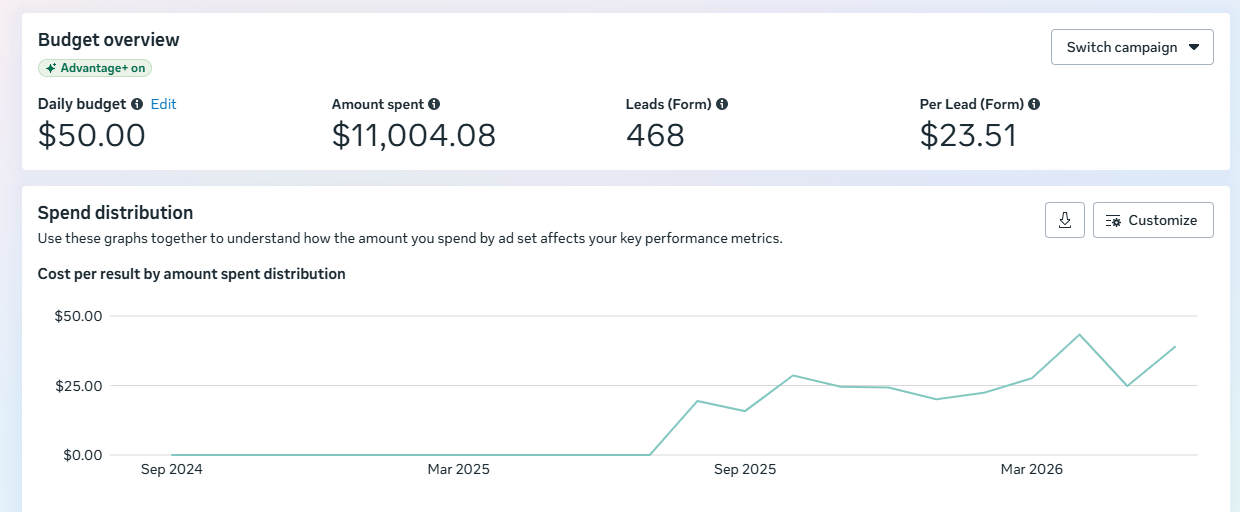
I started with a focused campaign for the Muslim community, using an initial daily budget of approximately CAD $16.
Rather than spreading the limited budget across multiple campaigns immediately, I concentrated on validating one acquisition approach first.
The initial strategy focused on three areas:
-
Campaign structure and audience strategy
-
Community-specific messaging and creative development
-
Continuous creative performance and lead quality analysis
The goal was not simply to reach more people. It was to help relevant potential customers recognize that the cemetery's services matched their needs.
Finding and Scaling Winning Creatives
Creative testing became a continuous part of the marketing system.
I developed creative angles, scripts, and production guidelines, while the final graphic and video assets were produced based on those directions. I then analyzed how people responded to different image and video creatives.
When a video had a strong opening but lost audience attention later, I focused on improving the weaker sections rather than automatically replacing the entire concept.
When an existing creative angle started losing effectiveness, I developed new concepts instead of continuing to rely on the same message.
The optimization process followed a simple cycle:
Analyse performance → Identify the problem → Keep what works → Improve weak elements → Test again.
As campaign performance developed, the daily budget increased from approximately CAD $16 to CAD $32 and eventually CAD $50.
Expanding the System Across Communities
After establishing the initial campaign approach, I applied the same strategic process to other audience groups.
Separate campaigns and creative strategies were developed for Muslim, secular, Christian, and Filipino communities.
Each campaign used messaging designed for its intended audience rather than relying on a single generic advertisement.
Over time, the business developed a multi-campaign lead generation system capable of supporting a larger marketing investment.
Reducing Cost Per Result
Scaling did not mean performance improved in a straight line. At one stage, creative fatigue and saturation of an existing angle caused the average daily cost per result to increase to approximately CAD $48.06.
Rather than accepting the higher cost, I reviewed campaign performance, creative response, and delivery data to identify opportunities for improvement.
Following further optimization, the average daily cost per result decreased to CAD $16.52 during the subsequent comparison period.

The same comparison period also showed a substantial improvement in average daily results.

The comparison showed a 65.6% decrease in cost per result and a 166.7% increase in average daily results, from 1.1 to 2.9.
These improvements reinforced the importance of continuous campaign analysis and creative optimization rather than treating advertising as a one-time setup.
Campaign Results: 468 Leads
One active Muslim-focused campaign generated 468 Meta Instant Form leads, with an average cost per lead of CAD $23.51.
The campaign also delivered more than 611,000 impressions and continued running at approximately CAD $50 per day in the supplied campaign report.


During one review of approximately 150 leads, the client's sales team identified only one lead as irrelevant. This result applied to that specific review and should not be interpreted as a guarantee that every lead generated was qualified.
The business offers pre-planning services, with individual burial plots priced at approximately CAD $12,000 and double plots at around CAD $14,000. This made lead quality especially important: the objective was to connect the business with relevant potential customers, not simply maximize form submissions.
Improving Lead Quality Without Adding Unnecessary Friction
The campaigns use Meta Instant Forms because they have consistently produced strong results for this business.
I reviewed different form structures and analyzed how changes affected lead volume and quality.
Rather than depending on SMS verification and adding unnecessary friction, I incorporated relevant qualifying questions into the form. The purpose was to make it easier for genuine prospects to submit their information while collecting useful details for the sales team.
This approach helped maintain a balance between accessibility, lead qualification, and the information needed for follow-up.
Connecting Marketing With the Sales Process
Generating a lead is only the first part of an effective marketing system. Lead information also needs to reach the right people and systems without relying on manual data transfer.
I designed and built a Make automation workflow connecting Meta lead generation with the client's internal sales process and CRM.
Workflow:
Meta Lead Form → Email Notification → Slack Notification → Google Sheets → Pipedrive CRM

The automation distributes incoming lead information to the relevant channels, preserves records in Google Sheets for future marketing analysis, and creates the required contact and lead records in Pipedrive.
The sales team can then manage and follow up with leads through its existing sales process.
This creates a connected workflow from advertising to lead management: marketing generates the lead, automation moves and preserves the data, and the CRM provides a structured place for the sales team to manage follow-up.
The Marketing System Today
What started as a limited Meta Ads test has developed into a multi-campaign lead generation system.
The business now has:
-
Separate acquisition campaigns for several key communities
-
A continuous creative testing and refresh process
-
Lead qualification through optimized Instant Forms
-
Automated lead distribution and CRM integration
-
Ongoing campaign analysis and optimization
The broader marketing system now generates close to 200 leads per month, supported by a monthly marketing investment exceeding CAD $4,500.
The growth in marketing investment reflects the expansion of acquisition activity as the system developed. It is not, by itself, a claim of revenue growth or profitability.
My Role
My responsibilities covered the Meta marketing system from initial strategy through ongoing growth and optimization.
Meta Ads Strategy
-
Campaign strategy and structure
-
Audience strategy and community-specific messaging
-
Campaign optimization and budget scaling
Creative Strategy
-
Creative angles, scripts, and production guidelines
-
Image and video performance analysis
-
Creative testing, refinement, and refresh decisions
Lead Generation and Qualification
-
Meta Instant Form optimization
-
Qualifying questions and lead quality analysis
-
Balancing lead volume with submission friction
Marketing Automation
-
Make automation design and implementation
-
Lead data flow between Meta, email, Slack, Google Sheets, and Pipedrive
-
Automated lead distribution and CRM record creation
The Outcome
The business moved from an inconsistent advertising approach to a structured, multi-campaign lead generation system supported by continuous optimization and automated lead management.
The system connects audience strategy, community-specific creative, lead generation, form qualification, automation, CRM management, and ongoing performance analysis.
My focus was not simply to launch ads. It was to build a marketing process that could generate leads, support the sales team, and improve over time based on campaign data.
Need Similar Growth in Your Business?
Let's discuss how to optimize your advertising, tracking, and conversion funnel.
Schedule Consultation